Calvin University carbon neutrality presentation
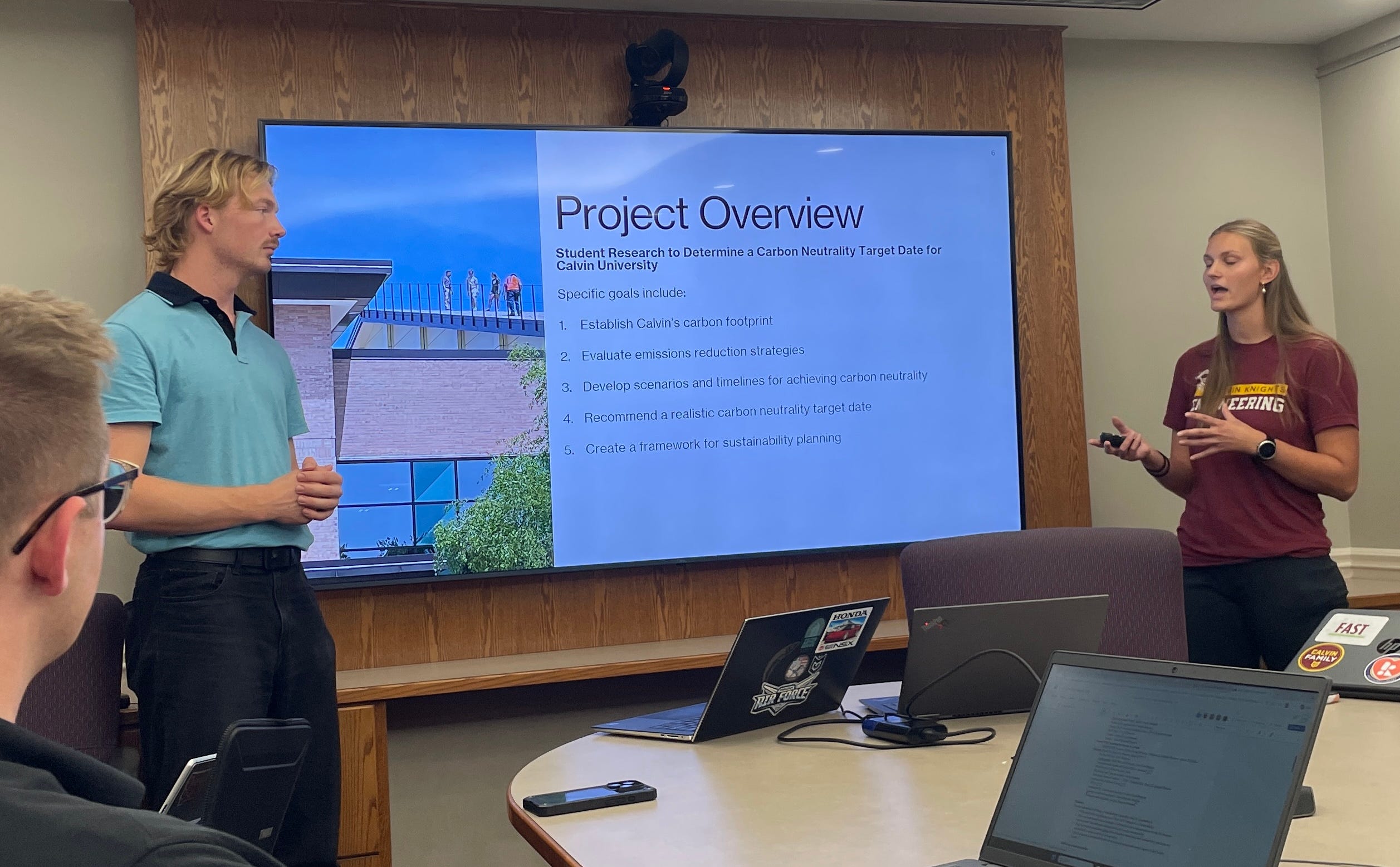
In Summer 2026, I supervised rising senior students Anneke Kuperus and Dylan Meengs to develop the first realistic carbon neutrality plan for Calvin University. We worked with Jennifer Ambrose, Brett Hoogewind, and Nick Koppenol (all from Calvin Facilities) to develop a practical and feasible approach that accounts for Calvin’s context, including location, geology, and infrastrucutre. Today, the students presented their excellent work to the Environmental and Energy Sustainability Committee (EESC).
Their innovative proposal for a Calvin Solar Revolving Fund (CSRF, modeled after the Calvin Energy Recovery Fund, CERF) is summarized in the following graph.
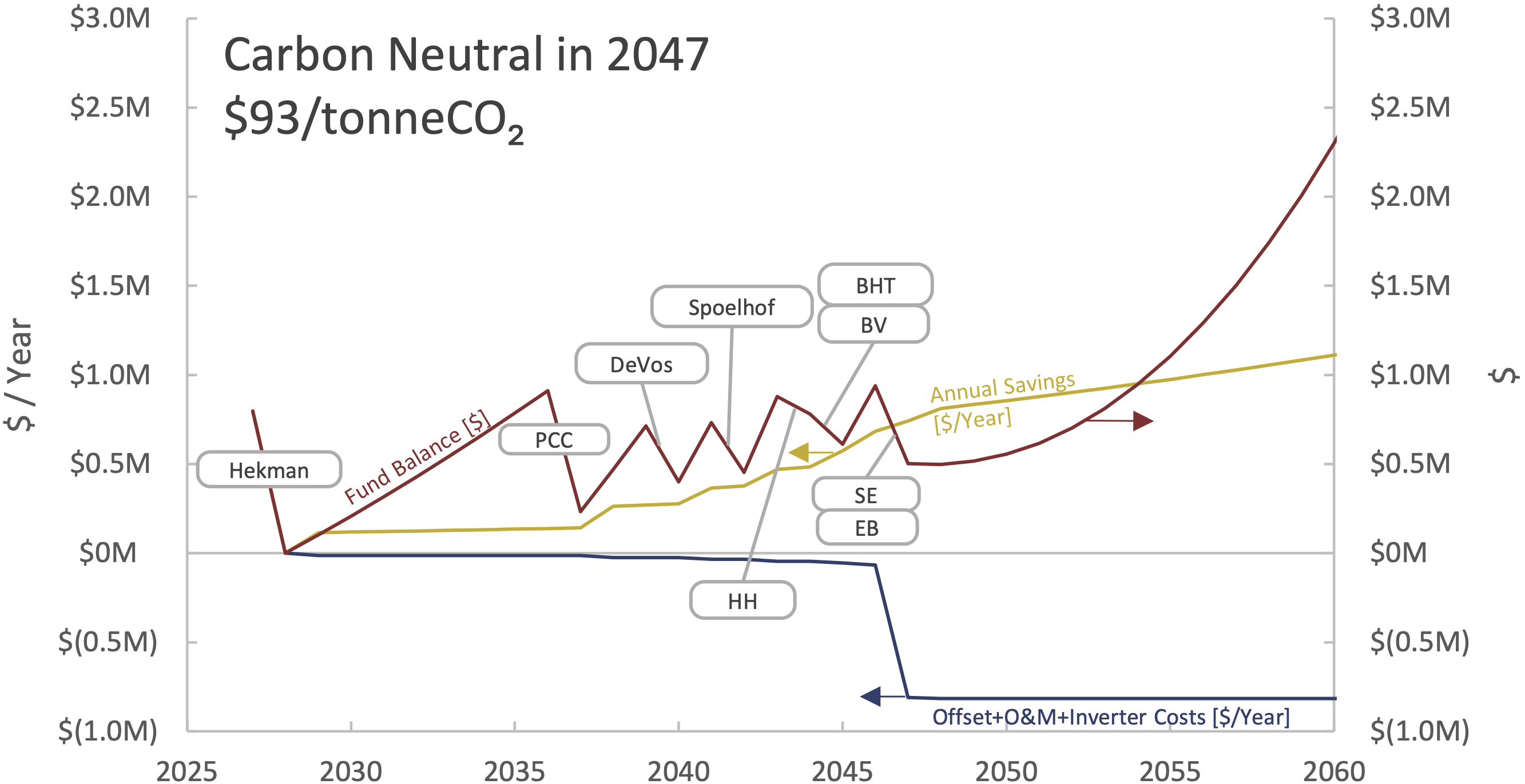
A sequence of solar photovoltaic installations on roofs across campus can provide annual electricity cost savings. The savings can provide funding for carbon offset purchases, moving our carbon neutrality date at least a decade earlier.
The presentation was well-received, and the students have been invited to present to the university’s Executive Leadership Team in the coming weeks. Here is the abstract of their report:
Calvin University committed to become carbon neutral by 2057 when former President Michael Le Roy signed the American College and University Presidents’ Climate Commitment (ACUPCC) in 2017. In 2026, Calvin withdrew from the ACUPCC to reduce costs. The Environmental and Energy Sustainability Committee (EESC) commissioned research, implemented by Facilities, to create a realistic plan for carbon neutrality and propose an earlier carbon neutrality date. This report analyzes Calvin’s carbon emissions from 2002-present, projects future emissions, and proposes a feasible path to carbon neutrality sooner than 2057. To become carbon neutral, Calvin University needs to offset the projected future Scope 1 (natural gas) emissions of 7920 tonneCO2/year. Options evaluated included wind power, air- and ground-source heat pumps, building efficiency, solar power, and carbon offsets. Given analysis of feasible options toward carbon neutrality, we recommend procuring high-quality carbon offsets using energy cost savings from a build-out of rooftop solar, funded by a Calvin Solar Revolving Fund (CSRF). Using this strategy, Calvin would become carbon neutral by 2047 under a high offset cost scenario ($93/tonneCO2) and 2038 under a low offset cost scenario ($29/tonneCO2).
Full details can be found in their final report.